Ahad, 10 April 2011

US Omega-6 and Omega-3 Fat Consumption over the Last Century

Omega-6 and omega-3 polyunsaturated fats (PUFA) are essential nutrients that play many important roles in the body. They are highly bioactive, and so any deviation from ancestral intake norms should probably be viewed with suspicion. I've expressed my opinion many times on this blog that omega-6 consumption is currently too high due to our high intake of refined seed oils (corn, soybean, sunflower, etc.) in industrial nations. Although it's clear that the quantity of omega-6 and omega-3 polyunsaturated fat have changed over the last century, no one had ever published a paper that attempted to systematically quantify it until last month (1).

Drs. Chris Ramsden and Joseph Hibbeln worked on this paper (the first author was Dr. Tanya Blasbalg and the senior author was Dr. Robert Rawlings)-- they were the first and second authors of a different review article I reviewed recently (2). Their new paper is a great reference that I'm sure I'll cite many times. I'm going to briefly review it and highlight a few key points.

1. The intake of omega-6 linoleic acid has increased quite a bit since 1909. It would have been roughly 2.3% of calories in 1909, while in 1999 it was 7.2%. That represents an increase of 213%. Linoleic acid is the form of omega-6 that predominates in seed oils.

2. The intake of omega-3 alpha-linolenic acid has also increased, for reasons that I'll explain below. It changed from 0.35% of calories to 0.72%, an increase of 109%.

3. The intake of long-chain omega-6 and omega-3 fats have decreased. These are the highly bioactive fats for which linoleic acid and alpha-linolenic acid are precursors. Arachidonic acid, DHA, DPA and EPA intakes have declined. This mostly has to do with changing husbandry practices and the replacement of animal fats with seed oils in the diet.

4. The ratio of omega-6 to omega-3 fats has increased. There is still quite a bit of debate over whether the ratios matter, or simply the absolute amount of each. I maintain that there is enough evidence from highly controlled animal studies and the basic biochemistry of PUFAs to tentatively conclude that the ratio is important. At a minimum, we know that excess linoleic acid inhibits omega-3 metabolism (3, 4, 5, 6). The omega-6:3 ratio increased from 5.4:1 to 9.6:1 between 1909 and 2009, a 78% increase.

5. The biggest factor in both linoleic acid and alpha-linolenic acid intake changes was the astonishing rise in soybean oil consumption. Soybean oil consumption increased from virtually nothing to 7.4% of total calories, eclipsing all sources of calories besides sugar, dairy and grains! That's because processed food is stuffed with it. It's essentially a byproduct of defatted soybean meal-- the second most important animal feed after corn. Check out this graph from the paper:

I think this paper is an important piece of the puzzle as we try to figure out what happened to nutrition and health in the US over the last century.

Selasa, 5 April 2011

Fat-ten-u

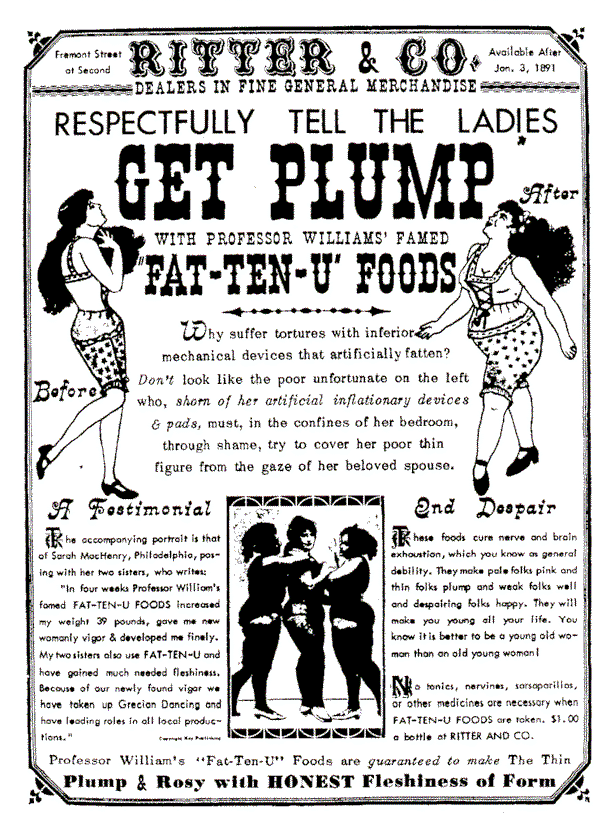
I recently bought the book Food in the United States, 1820s-1890. I came across an ad for an interesting product that was sold in the late 1800s called Fat-ten-u. Check your calendars, it's not April fools day anymore; this is for real. Fat-ten-u was a dietary supplement guaranteed to "make the thin plump and rosy with honest fleshiness of form." I found several more ads for it online, and they feature drawings of despondent, lean women and drawings of happy overweight women accompanied by enthusiastic testimonials such as this:
"FAT-TEN-U FOODS increased my weight 39 pounds, gave me new womanly vigor and developed me finely. My two sisters also use FAT-TEN-U and because of our newly found vigor we have taken up Grecian dancing and have roles in all local productions."
I'm dying to know what was in this stuff, but I can't find the ingredients anywhere.

I find this rather extraordinary, for two reasons:
  • Social norms have clearly changed since the late 1800s. Today, leanness is typically considered more attractive than plumpness.
  • Women had to make an effort to become overweight in the late 1800s. In 2011, roughly two-thirds of US women are considered overweight or obese, despite the fact that most of them would rather be lean.
A rhetorical question: did everyone count calories in the 1800s, or did their diet and lifestyle naturally promote leanness? The existence of Fat-ten-u is consistent with the idea that our bodies naturally "defended" a lean body composition more effectively in the late 1800s, when our diets were less industrialized. This is supported by the only reliable data on obesity prevalence in the 1890s I'm aware of: body height and weight measurements from over 35,000 Union civil war veterans aged 40-69 years old (1). In that group of Caucasian men, obesity was about 10% of what it is today in the same age group. Whether or not you believe that this sample was representative of the population at large, I can't imagine any demographic in the modern US with an obesity prevalence of 3 percent (certainly not 60 year old war veterans).

Here are two more ads for Fat-ten-u and "Corpula foods" for your viewing pleasure:

Jumaat, 1 April 2011

Great New Product

Do you feel sad sometimes? Are you tired when you get up in the morning? Do you get winded running sprint intervals? I've just found a great new product that I think can help. It's called bozolol.

Bozolol is an amazing nutritional supplement extracted from the bozolol berry, harvested wild in the heart of the Amazon rainforest. To the native Ilotaca tribe, the bozolol berry is sacred because it alters the molecules in your brain to make you smarter AND sexier.

Here's how it works: bozolol actually
increases the uptake of fat-soluble vitamins from your food, while reducing inflammation in the arteries and helping you shed fat faster than a pork roast! Guaranteed! Learn more about it here. 

April fools!

Rabu, 30 Mac 2011

Dr. Kevin Patterson on Western Diets and Health

A few readers have pointed me to an interesting NPR interview with the Canadian physician Kevin Patterson (link). He describes his medical work in Afghanistan and the Canadian arctic treating cultures with various degrees of industrialization. He discusses the "epidemiological transition", the idea that cultures experience predictable changes in their health as they go from hunter-gatherer, to agricultural, to industrial. I think he has an uncommonly good perspective on the effects of industrialization on human health, which tends to be true of people who have witnessed the effects of the industrial diet and lifestyle on diverse cultures.

A central concept behind my thinking is that it's possible to benefit simultaneously from both:

  • The sanitation, medical technology, safety technology, law enforcement and lower warfare-related mortality that have increased our life expectancy dramatically relative to our distant ancestors.

  • The very low incidence of obesity, diabetes, coronary heart disease and other non-infectious chronic diseases afforded by a diet and lifestyle roughly consistent with our non-industrial heritage.

But it requires discipline, because going with the flow means becoming unhealthy.


Sabtu, 26 Mac 2011

Randy Tobler Show: Welcome

This morning, I had a conversation with Dr. Randy Tobler on his radio show "Vital Signs", on 97.1 FM News Talk in St Louis. Dr. Tobler is an obstetrician-gynecologist with an interest in nutrition, fitness and reproductive endocrinology from a holistic perspective. He asked me to appear on his show after he discovered my blog and found that we have some things in common, including an interest in evolutionary/ancestral health. We talked about the history of the American diet, the health of non-industrial cultures, what fats are healthiest, and the difference between pastured and conventional meat/dairy-- we took a few questions from listeners-- it was fun.

The show is available as a podcast here (3/26 show), although as far as I can tell, you need iTunes to listen to it. My section of the show starts around 8:20.

To everyone who arrived here after hearing me on the air this morning: welcome! Here are a few posts to give you a feel for what I do here at Whole Health Source:

The Coronary Heart Disease Epidemic

US Weight, Lifestyle and Diet Trends, 1970-2007
Butter vs. Margarine Showdown
Preventing and Reversing Tooth Decay
The Kitavans: Wisdom from the Pacific Islands
Potatoes and Human Health, Part I, Part II and Part III
Traditional Preparation Methods Improve Grains' Nutritional Value
Real Food XI: Sourdough Buckwheat Crepes
Glucose Tolerance in Non-industrial Cultures
Tropical Plant Fats: Palm Oil

It's Time to Let Go of the Glycemic Index

Rabu, 23 Mac 2011

Safflower Oil Study

A few people have sent me a new study claiming to demonstrate that half a tablespoon of safflower oil a day improves insulin sensitivity, increases HDL and decreases inflammation in diabetics (1). Let me explain why this study does not show what it claims.

It all comes down to a little thing called a control group, which is the basis for comparison that you use to determine if your intervention had an effect. This study didn't have one for the safflower group. What it had was two intervention groups, one given 6.4g conjugated linoleic acid (CLA; 50% c9t11 and 50% t10c12-CLA) per day, and one given 8g safflower oil. I have to guess that this study was originally designed to test the effects of the CLA, with the safflower oil group as the control group, and that the interpretation of the data changed after the results came in. Otherwise, I don't understand why they would conduct a study like this without a control group.

Anyway, they found that the safflower oil group did better than the CLA group over 16 weeks, showing a higher insulin sensitivity, higher HDL, lower HbA1c (a marker of average blood glucose levels) and lower CRP (a marker of inflammation). But they also found that the safflower group improved slightly compared to baseline, therefore they decided to attribute the difference to a beneficial effect of safflower oil. The problem is that without a control (placebo) group for comparison, there's no way to know if the improvement would have occurred regardless of treatment, due to the season changing, more regular check-ups at the doctor's office due to participating in a study, or countless other unforeseen factors. A control group is essential for the accurate interpretation of results, which is why drug studies always have placebo groups.

What we can say is that the safflower oil group fared better than the CLA group, because there was a difference between the two. However, what I think really happened is that the CLA supplement was harmful and the small dose of safflower oil had no effect. Why? Because the t10c12 isomer of CLA, which was half their pill, has already been shown by previous well-controlled studies to reduce insulin sensitivity, decrease HDL and increase inflammatory markers at a similar dose and for a similar duration (2, 3). The safflower oil group only looked good by comparison. We can add this study to the "research bloopers" file.

It's worth noting that naturally occurring CLA mixtures, similar to those found in pastured dairy and ruminant fat, have not been shown to cause metabolic problems such as those caused by isolated t10c12 CLA.

Jumaat, 18 Mac 2011

New Ancestral Diet Review Paper

Pedro Carrera-Bastos and his colleagues Maelan Fontes-Villalba, James H. O'Keefe, Staffan Lindeberg and Loren Cordain have published an excellent new review article titled "The Western Diet and Lifestyle and Diseases of Civilization" (1). The paper reviews the health consequences of transitioning from a traditional to a modern Western diet and lifestyle. Pedro is a knowledgeable and tireless advocate of ancestral, primarily paleolithic-style nutrition, and it has been my privilege to correspond with him regularly. His new paper is the best review of the underlying causes of the "diseases of civilization" that I've encountered. Here's the abstract:
It is increasingly recognized that certain fundamental changes in diet and lifestyle that occurred after the Neolithic Revolution, and especially after the Industrial Revolution and the Modern Age, are too recent, on an evolutionary time scale, for the human genome to have completely adapted. This mismatch between our ancient physiology and the western diet and lifestyle underlies many so-called diseases of civilization, including coronary heart disease, obesity, hypertension, type 2 diabetes, epithelial cell cancers, autoimmune disease, and osteoporosis, which are rare or virtually absent in hunter–gatherers and other non-westernized populations. It is therefore proposed that the adoption of diet and lifestyle that mimic the beneficial characteristics of the preagricultural environment is an effective strategy to reduce the risk of chronic degenerative diseases.
At 343 references, the paper is an excellent resource for anyone with an academic interest in ancestral health, and in that sense it reminds me of Staffan Lindeberg's book Food and Western Disease. One of the things I like most about the paper is that it acknowledges the significant genetic adaptation to agriculture and pastoralism that has occurred in populations that have been practicing it for thousands of years. It hypothesizes that the main detrimental change was not the adoption of agriculture, but the more recent industrialization of the food system. I agree.

I gave Pedro my comments on the manuscript as he was editing it, and he was kind enough to include me in the acknowledgments.